01
EAT
Where Matosinhos Still Eats Like Itself
At Salta o Muro, the old grammar of the fishing district remains intact: charcoal, shared tables, ceramic bowls and whatever the sea provides.
Notes From Porto
Share
5 min
Aug 23, 2026

IMAGE
Hero: Alex Teixeira / Unsplash. Additional media: Andy Kennedy and Maksym Kaharlytskyi / Unsplash.
New York has its hot dogs. Naples has pizza. Philadelphia has the cheesesteak. Porto has a sandwich covered in molten cheese and hot sauce that requires a knife, a fork, and, ideally, no important plans for the next two hours.
Calling a francesinha a sandwich is technically correct, but only just. It is like calling the Douro a river or São Bento a train station: accurate, but suspiciously incomplete.
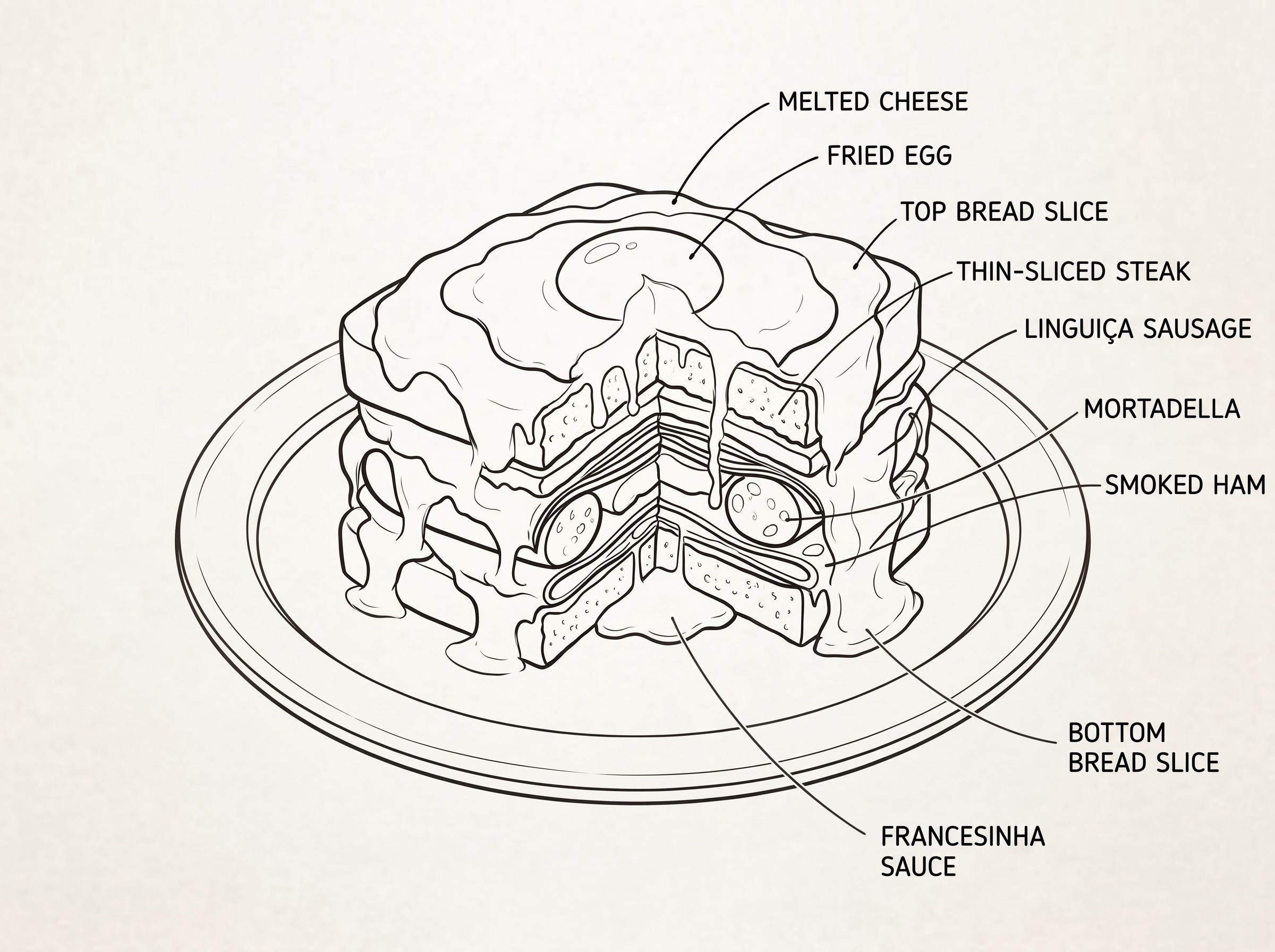
The contemporary Porto version normally begins with bread layered with several meats—often ham, linguiça, fresh sausage, and a thin steak or roast meat. Cheese is draped over the entire construction and melted around it. A hot, seasoned sauce surrounds or covers the whole thing. Fries arrive beside it, underneath it, or wherever they can find space. A fried egg on top is common, although not compulsory.
It is eaten with a knife and fork. Attempting otherwise is less a display of authenticity than a laundry decision.
In brief
A francesinha is Porto’s hot, layered meat sandwich, covered in melted cheese and a house-made sauce. The modern dish is widely connected to Daniel David da Silva and A Regaleira in the 1950s, where an idea inspired by the French croque monsieur was reworked using Portuguese meats and a spicy sauce.
If the croque monsieur arrived in Porto wearing a neat Parisian jacket, the francesinha is what happened after the city gave it a larger coat, introduced it to linguiça, and convinced it to stay out late.
The version served across Porto today is not one fixed recipe. Bread, meats, sauce, spice, and texture vary from house to house. Every restaurant believes its sauce is different. Many believe it is a secret. A surprising number behave as though the recipe is protected somewhere beneath the Palácio da Bolsa.
A modern tradition
The francesinha feels as though it must have emerged from an ancient northern kitchen, possibly during a winter so cold that someone decided cheese alone was no longer sufficient protection.
Its accepted history is considerably more recent.
The story most closely associated with the dish leads to A Regaleira on Rua do Bonjardim. The restaurant’s history, Porto’s municipal Comércio com História program, and the Museu da Cidade all connect Daniel David da Silva with a sandwich inspired by the croque monsieur after time spent in France.
A Regaleira dates its creation to 1952. As with many food origin stories, the details have become more certain with every retelling. The responsible phrasing is that the francesinha is widely credited to Silva and the restaurant in the early 1950s.
The original described by the municipal heritage record was not necessarily the large square construction most people now recognize. It used small bread, roast meat, and smoked meats with a secret spicy sauce. Porto’s restaurants expanded, standardized, and reinterpreted it over the decades that followed.
Tradition is sometimes an old recipe carefully preserved. In this case, it is a relatively young idea that Porto adopted so completely that arguing about the correct version became part of the tradition.
What is inside one
There is no single legally protected composition, but the familiar Porto structure usually includes:
• Slices of white bread capable of absorbing sauce without immediately surrendering.
• Fiambre or another form of ham.
• Linguiça or smoked sausage.
• Fresh sausage.
• A thin steak, roast meat, or another substantial central layer.
• Mild melting cheese wrapped over the top and sides.
• A hot sauce created by the individual restaurant.
• Fries.
• An optional fried egg.
“Optional” is important here. Some people consider the egg essential. Others regard it as an unnecessary extension built on top of an already completed building. Porto contains both groups, and so far they continue to coexist.
Vegetarian and seafood versions now appear too. Some are thoughtful reinterpretations; others feel like the chef lost a bet. But they reveal how much the dish depends on balancing smoke, salt, fat, spice, and texture rather than simply assembling a particular list of meats.
The sauce is the argument
People discuss the meat. They argue about the sauce.
The sauce is where restaurant loyalties are formed, friendships are tested, and otherwise reasonable adults begin speaking with the seriousness of constitutional lawyers.
Recipes are guarded and vary widely. Beer, tomato, stock, wine or spirits, chili, and aromatics may all be involved, but no responsible description can turn those possibilities into one definitive formula.
Some sauces are bright and spicy. Others are darker, sweeter, or richer. Some cling to the cheese; others behave more like soup. The color ranges from orange to deep red-brown, occasionally approaching something that looks capable of removing paint.
Heat is only part of the calculation. A very spicy sauce is not automatically a very good one, just as a very loud person is not automatically the most interesting person at the table.
The sauce should connect the bread, meat, and cheese. It should provide enough acidity and spice to interrupt the richness, without bullying every other ingredient into silence.
How to judge the whole plate
The best-known dish in a city attracts excess. Once the francesinha became famous, it was probably inevitable that someone would make it taller, heavier, hotter, and impossible to photograph without a wide-angle lense.
More is not always better.
A good francesinha needs proportion:
• Bread that absorbs the sauce without immediately collapsing.
• Meat with distinct textures rather than one anonymous layer.
• Cheese properly melted across the top and sides.
• Sauce served hot, with enough acidity and spice to balance the richness.
• Fries sturdy enough to survive at least their first encounter with the sauce.
The worst versions confuse quantity with generosity. They arrive looking like a dare: too much bread, too much cheese, and a sauce that exists mainly to conceal what is underneath.
The best versions are still substantial, but they make sense from one bite to the next.
Why it belongs to Porto
A city’s signature food rarely explains the whole city. New Yorkers do not live exclusively on hot dogs, although the sidewalk carts appear determined to keep the option available. The people of Naples occasionally eat things that are not round. Porto is not defined by the francesinha—but the dish does carry something recognizably local.
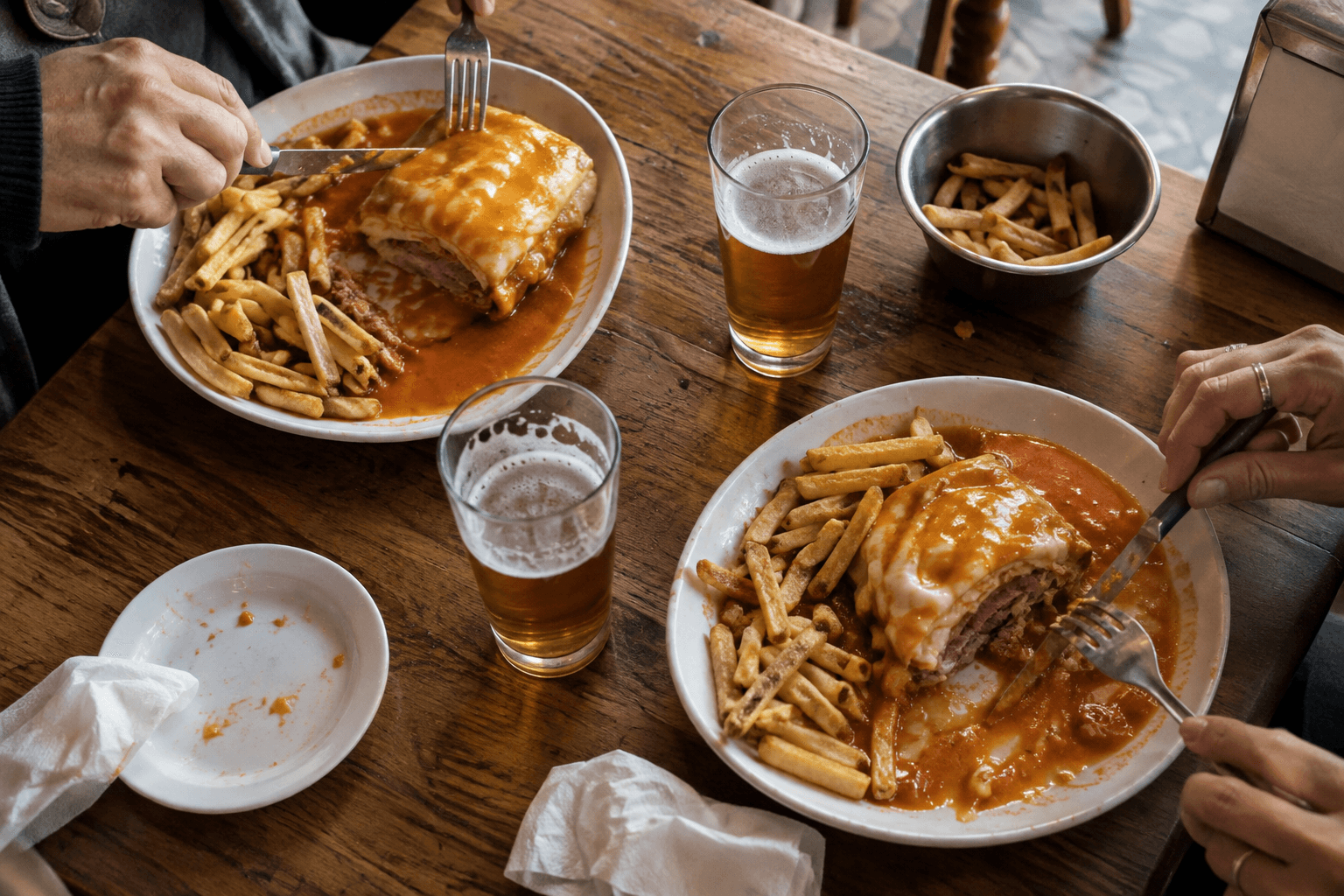
It is direct, generous, and uninterested in behaving delicately for visitors. It arrives without an apology and with enough cheese to make an apology seem pointless anyway.
It belongs to restaurants where lunch can become the afternoon; where the television may be showing soccer; where the waiter has already decided you need another beer; and where the person at the next table is prepared to explain why you have ordered from the wrong place.
The francesinha is also democratic in the old café sense. It is not designed to be decoded with specialist vocabulary. You do not need a tasting menu, a dress code, or a small lecture about fermentation before eating it.
Nobody asks you to identify notes of woodland moss. Nobody places the sauce beside the plate with tweezers. Nothing arrives on a stone.
You need an appetite.
Preferably, you also need time.
What to order the first time
Order the house’s standard version before choosing the largest or most theatrical option. Ask whether the egg is included. Let the restaurant’s normal sauce arrive before requesting extra spice.
Do not choose entirely by size. A francesinha is lunch, not an engineering project.
And ignore anyone who tells you there is only one acceptable place to eat one. Asking Porto residents for the best francesinha is like asking a large family who makes the correct Sunday lunch: you are unlikely to receive a simple answer, but you may learn about several old disagreements.
Try several. Notice the sauce. Decide whether you prefer it sweeter, sharper, lighter, or more intense. Develop an opinion with unreasonable confidence.
That, too, is part of eating a francesinha.
Where to try one in Porto
There is no single correct francesinha, which is fortunate because Porto would otherwise have very little left to argue about. These four places offer useful points of comparison rather than a definitive ranking.
• A Regaleira — Start with the history. The modern francesinha is widely credited to Daniel David da Silva here in the early 1950s. Its version helps explain where the dish began before the city made it larger, richer, and more argumentative.
• Café Santiago — A central, traditional benchmark and one of Porto’s best-known houses for the dish. Go here to understand the version many visitors picture when someone says “francesinha.”
• Yuko Tavern — A neighborhood favorite away from the busiest part of the center, suited to readers who want to join the local sauce debate rather than simply complete a tourist checklist.
• Brasão — A more polished contemporary interpretation, useful for first-time visitors who want the full dish in a comfortable, designed restaurant setting.
Treat this as a tasting route, not a league table. Check current hours and booking details with each restaurant before going.
A francesinha succeeds when the sauce connects the parts. It fails when the sauce simply hides them.
Source note
Primary references: Porto’s Comércio com História record for A Regaleira; Museu da Cidade do Porto; and A Regaleira’s own account of its history. The francesinha is widely credited to Daniel David da Silva and A Regaleira in the early 1950s, although details surrounding famous food origin stories should never be treated as completely uncontested.

FIELD NOTE
Salta o Muro does not modernise the old grammar of Matosinhos dining. It keeps speaking it.
Notes From Porto
NOTES, OCCASIONALLY
A quiet letter from Porto.
New stories and editorial notes, sent when there is something worth passing on.
NOTES FROM PORTO
Independent editorial publication