NHR Is Dead. Here's What Actually Replaced It
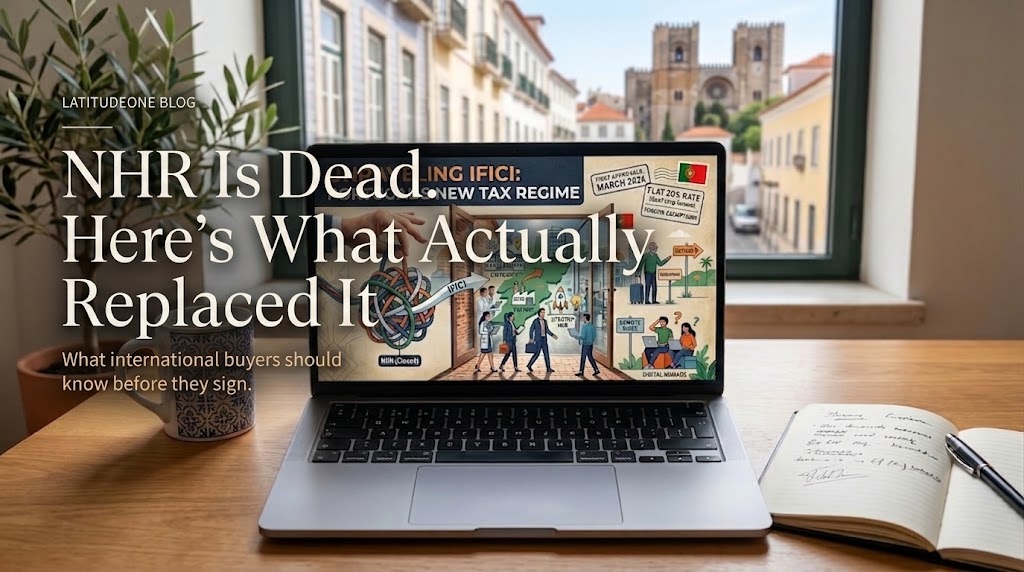
A plain-language guide to IFICI, the tax regime everyone's still getting wrong
Quick answer: Portugal's Non-Habitual Resident (NHR) tax regime closed at the end of 2023. It was replaced by IFICI, officially the Tax Incentive for Scientific Research and Innovation, sometimes called "NHR 2.0." IFICI offers a flat 20% tax rate on qualifying Portuguese income and exemptions on most foreign income, for up to ten years, but only for people working in specific qualifying roles. Retirees living on a pension are no longer covered.
If you've spent any time in expat Facebook groups or forums, you've probably seen someone mention "NHR" like it's still the golden ticket to living in Portugal tax free. It isn't. Most people just haven't caught up.
That nickname, NHR 2.0, is a little misleading, and it's the source of most of the confusion we hear from people thinking about the move. It sounds like an upgrade of the same thing. It isn't quite that. It's a narrower, more targeted regime, built for a different kind of resident than the one NHR was designed for. If you're picturing a retiree with a pension and some savings settling into a quiet life by the coast, this new regime probably isn't for you. If you're picturing someone building a career, a company, or a research project in Portugal, it might be exactly what you need.
Here's what IFICI actually is, who qualifies for it, and where people keep tripping up.
What is IFICI (NHR 2.0)?
IFICI stands for Incentivo Fiscal à Investigação Científica e Inovação, the Tax Incentive for Scientific Research and Innovation. It's Portugal's official replacement for NHR, in force since January 2024, with the first wave of applications formally approved in March 2026.
Strip away the acronyms and IFICI does one simple thing. It offers a flat 20% tax rate on qualifying income earned in Portugal, instead of Portugal's normal sliding scale, which climbs as high as 48%. On top of that, most income you earn outside Portugal, including foreign dividends, interest, and gains on shares, is generally exempt from Portuguese tax altogether, as long as it isn't coming from a blacklisted tax haven.
Those benefits can last up to ten consecutive tax years.
That's the appealing part, and it's genuinely significant if you qualify. The catch is in that word: if.
IFICI eligibility requirements: who actually qualifies
Under the old NHR, qualifying was almost a formality. Move to Portugal, hadn't lived there in the past five years, tick a box, done.
IFICI works differently. You still need that same five year gap. If you've been a Portuguese tax resident at any point in the last five years, you're not eligible, full stop. But beyond that, you also need to be doing something specific in Portugal. The regime recognizes seven categories of qualifying activity, known as the seven IFICI routes, and you need to fit into one of them every single year you want to keep the benefit.
The seven routes are, roughly:
University professors and scientific researchers
People taking up roles tied to approved investment projects
Skilled professionals working at large export focused or heavily invested companies
Employees or board members at companies formally recognized as important to the Portuguese economy
Researchers working on formally certified R&D projects
Employees or board members of certified Portuguese startups
Residents of the Azores or Madeira (this route exists on paper but isn't active yet)
Of these, the startup route tends to be the most accessible for newcomers, since it doesn't require a specific degree or years of documented experience, just a genuine role at a startup certified by Startup Portugal.
Notice what's missing from that list: simply retiring here on a pension. Under the old NHR, retirees got a favorable 10% rate, or in some cases full exemption, on foreign pension income. Under IFICI, pensions get no special treatment at all. They're taxed at the same progressive rates as any other Portuguese resident's income. If you're moving to Portugal purely to retire, IFICI mostly isn't built with you in mind. Digital nomads working remotely for a foreign employer, and people with mostly passive income, are in a similar position. The routes technically exist, but they take real structuring to satisfy, not just paperwork.
IFICI vs NHR: what actually changed
| Old NHR | IFICI (NHR 2.0) |
|---|---|---|
How you qualify | Simply move to Portugal, no prior residency in 5 years | Must hold a qualifying role under one of 7 routes, every year |
Duration | 10 years | 10 years |
Portuguese income tax rate | 20% flat (qualifying professions) | 20% flat (qualifying IFICI activity) |
Foreign pension income | 10% flat rate, or exempt | Not covered, taxed at standard progressive rates |
Foreign capital gains on shares | Exempt only if taxed in the source country | Exempt, without that condition |
Foreign dividends, interest, royalties | Exempt if taxed in source country | Exempt, if not from a blacklisted jurisdiction |
Two changes stand out. Retirees lost their main benefit entirely. Investors with foreign shares actually gained ground, since IFICI drops a restriction the old NHR had on foreign capital gains.
The details that trip people up
A few things are worth knowing before you get your hopes up, or worse, have them dashed by a well meaning forum post.
It has to be real, not just paperwork. Portugal has made clear it's watching for arrangements that exist purely on paper, such as a company with no real activity, or a "job" that's really just a way to check a box. The tax authority reviews eligibility every year, not just once at the start, so a structure with no substance behind it is a real risk, not a shortcut.
The clock starts the moment you arrive. You generally need to already meet a qualifying activity in the same tax year you become a Portuguese resident. Miss that window, and in some cases you lose access to the regime permanently, not just for that year.
There's a hard application deadline. Once you qualify for a given tax year, the formal application needs to go in by January 15 of the following year. Miss that specific date and you can lose the benefit for that year, even if you genuinely met the criteria.
It doesn't stack with everything else. If you're a younger worker benefiting from Portugal's separate IRS Jovem tax break, you can't also claim IFICI. And if you're already on the old NHR regime, you can't switch to IFICI either. You simply see out your original ten years under the old rules.
Who is IFICI actually good for?
Put simply, people who are moving to Portugal to work, not just to live here. Researchers, employees at qualifying companies, startup founders and early employees, and professionals taking on roles at export focused or investment backed businesses stand to gain the most. For that group, the numbers can be substantial. A 20% flat rate against a top marginal rate of 48% is not a small difference, and the exemption on foreign investment income can matter a great deal if you hold shares or other assets abroad.
If your plan is retirement, or income built mainly around a pension, this isn't really the regime being offered to you anymore, and it's worth going into the move with that expectation set correctly rather than discovering it later.
Frequently asked questions
Is NHR still available in Portugal? No. Portugal's original Non-Habitual Resident regime closed to new applicants at the end of 2023. Anyone already approved under the old NHR continues under those rules until their ten years expire, but new arrivals fall under IFICI instead.
What is the IFICI tax rate? A flat 20% on qualifying Portuguese employment or self-employment income, compared with Portugal's standard progressive rates of up to 48%.
Does IFICI cover pension income? No. Unlike the old NHR, IFICI does not offer any reduced rate or exemption on pension income, foreign or domestic. Pensions are taxed at standard progressive rates.
Can digital nomads qualify for IFICI? Yes, in principle, through one of the seven eligibility routes, but it requires a genuine qualifying structure from the year you arrive, not just remote work for a foreign employer. Many digital nomads assume they'll qualify automatically and are disappointed.
What is the deadline to apply for IFICI? January 15 of the year following the tax year in which you first qualify.
Can I switch from the old NHR to IFICI? No. If you're already benefiting from the old NHR, you stay on it until it expires. The reverse is also true: IFICI beneficiaries cannot move to the old NHR regime.
Is IFICI good for retirees? Generally, no. Retirees relying on pension income are the group most affected by the change from NHR to IFICI, since pensions receive no preferential treatment under the new regime.
The honest bottom line
IFICI is real, it's working (the first wave of applications was approved in March 2026), and for the right kind of applicant it's one of the more generous tax regimes on offer anywhere in Europe. But it rewards careful planning far more than the old NHR ever did. The people who get the most out of it are the ones who understood, before they packed a single box, exactly which of the seven routes they'd be walking through the door under.
This is general information, not tax advice. IFICI eligibility depends on your specific situation, and Portuguese tax law continues to evolve. If you're weighing a move and want to understand what it would actually mean for your income, a conversation with a Portuguese tax specialist before you relocate will save you a lot of guesswork later.
Sources
FRESH Legal Group – IFICI (NHR 2.0): Portugal's New Tax Regime for Expats
Global Citizen Solutions – NHR Portugal: Is It Still Available in 2026?
Global Citizen Solutions – Portugal NHR 2.0: A Guide to the IFICI Tax Regime in 2026
PortuTax – NHR 2.0 Portugal: IFICI Regime Explained for Expats
Touchdown – Portugal NHR 2.0 (IFICI) Tax Regime: 2026 Playbook
The Golden Portugal – Portugal NHR 2.0: Your Expat Guide in 2026



